How Is a Sense of Belonging Created?
A sense of belonging is not created because a person owns a place or returns to the same business; people feel that there is room for them when they are recognised, heard and treated consistently.
What is a sense of belonging?
Belonging is the feeling that one is not an outsider within a relationship, community or environment. Proximity alone does not create it. Acceptance, recognition, safe participation and the freedom to retain personal boundaries all contribute to the feeling.
Research on human needs shows that one request can express several needs at once, including safety, control, comfort and belonging. Self-determination theory also identifies relatedness, alongside autonomy and competence, as a basic psychological need. Applied carefully to service, these ideas lead to a practical conclusion: people want the task completed, but they also want to be seen, understood and respected while it is being completed.
I understand belonging as the point at which a customer can say, “I know how things work here, and I do not need to introduce my needs again.” Good service does not claim ownership of the person or place them in a fixed category. It creates a safe, clear and respectful space in which they can participate.
Why is belonging a basic human need?
People do not assess an environment only through physical safety. They also ask, often silently: “Am I accepted here?”, “Are they listening?”, “Who will help me if something changes?” and “Are my priorities being taken seriously?” The answers shape the entire experience.
When those answers remain uncertain, even an impressive setting can feel distant. By contrast, a modest setting can create a strong connection when the welcome is appropriate, the next step is clear and respect remains consistent. Belonging is rarely produced by one dramatic gesture. It develops through reliable behaviour repeated over time.
The practical benefit for the customer is ease. The person does not have to remain guarded, repeat every detail to prevent misunderstanding or guess how each employee will behave. Their energy can remain with their own experience and decision rather than being spent on managing the service.
Are recognition and personalisation the same?
Recognition is more than knowing a customer’s name. It means remembering relevant priorities, preferred communication and service-related choices accurately. Personalisation is the restrained use of that knowledge to make the service more suitable.
Repeatedly using a person’s name can appear personal, yet asking again for a need that was clearly explained before weakens recognition. A large number of surprises is not automatically thoughtful either. Attention that the person did not request may feel intrusive even when the intention is positive.
Responsible personalisation rests on three principles:
- Only information needed for the service is remembered.
- The information is used to provide a clear benefit.
- Privacy and the right to change a preference are protected.
In real estate, remembering budget, lifestyle priorities and the customer’s decision pace prevents irrelevant projects from being presented. In hospitality, understanding room, timing or communication preferences can simplify arrival. In transportation, knowing the route, luggage and meeting details reduces repetition. Recognition is not curiosity about the customer’s private life; it is the removal of unnecessary service effort.
How does continuity strengthen trust?
Belonging is not established through one excellent welcome. The first promise must be confirmed by the continuing experience. If attention is exceptional on one day and absent on the next, the customer becomes cautious again.
Continuity does not mean that every employee uses identical sentences. It means that the same values survive every contact point: accurate information, timely responses, follow-through on promises, respectful communication and visible responsibility when something changes.
This does not happen by accident. Notes must be kept properly, handovers must be complete, ownership must be clear and changes must be communicated at the right time. Training matters because a standard that depends solely on personal talent changes with the shift or the employee. A reliable system turns good intentions into consistent behaviour.
Continuity offers two direct benefits. First, repetition decreases. Second, the experience becomes predictable. The customer understands what kind of approach to expect at each stage. That predictability forms the secure ground on which belonging can develop.
When does a place become meaningful?
A physical setting does not create belonging by itself. Research on belonging shows the importance of feeling recognised within stable, respectful and positive relationships. A setting becomes personally meaningful when experience, memory and value become connected to it.
This is why an expensive design cannot produce the same feeling for everyone. A hotel room may have a remarkable view, yet it remains merely beautiful if the arrival does not respect the guest’s rhythm. A property may be architecturally strong, but it will not feel like home if it conflicts with everyday life, privacy, transportation or the desired social environment.
Simple conditions help a place gain meaning:
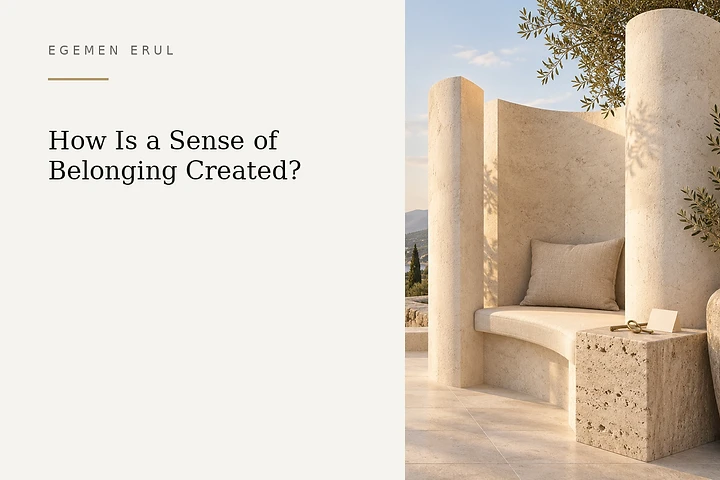
The approved visual expresses this idea through a sheltered seat, a key and a personal card. Belonging often begins before someone says, “This place is mine.” It begins with the quieter feeling: “Someone considered a place for me here.”
How can service make room for the person?
Making room for a person does not require saying yes to every request. It requires understanding the genuine need, explaining limits honestly and building a suitable solution together.
A useful first conversation does not stop at “What would you like?” It also explores why it matters, which condition is essential, what should be avoided and who will be affected by the decision. Listening is not passive waiting. It involves paying attention to spoken needs, unspoken concerns and behavioural signals without turning them into assumptions.
Service makes room for the customer when it:
- listens without interrupting,
- verifies instead of assuming,
- narrows options according to real priorities,
- avoids pressure during the decision,
- provides one reachable point of contact,
- accepts changing needs without treating them as a personal problem.
This strengthens the customer’s control. The person is not merely accepted by the process; they participate in the decision. Healthy belonging is not dependence. It is safe participation.
How are belonging and professional boundaries balanced?
Warm communication does not require blurred boundaries. Professional sincerity in premium service means being accessible, honest and consistent when needed. It does not mean entering a customer’s private life in order to appear close.
Remembering relevant preferences is valuable, but those details should be used only for the service, shared only with the people who need them and never turned into a performative surprise. “We recognise you” must not become “We know everything about you.”
Clear boundaries protect both sides. The customer understands why information is requested and how it will be used. The service provider states honestly what can and cannot be done. This transparency does not weaken trust; it gives the relationship a stable structure.
How is belonging designed in luxury service?
In luxury service, belonging does not come from expensive gifts or constant references to privilege. It comes from consistent respect for the customer’s time, preferences and decisions.
In hospitality, it means returning without having to explain the entire history again and experiencing an arrival that reflects relevant preferences. In casino and premium guest operations, it means not becoming lost between departments and having a request transferred accurately. In transportation, it means the meeting point, route and luggage details are prepared in advance. In real estate, it means there is a reachable professional not only before the sale but throughout the decision, delivery and after-sales period.
The principle is the same across all these sectors: the customer should not be excluded from the system, but should not have to carry its operational weight. Information, responsibilities and timing are coordinated in the background. What remains visible is a calm, understandable experience adapted to the person.
How is a sense of belonging protected?
For me, belonging does not mean telling a customer that they are “one of us”. It means accepting the person with their own identity, priorities and boundaries. I listen first. I then organise only the information required for the service, share it with the appropriate people and work to preserve the same approach at every contact point.
This requires discipline: accurate notes, clear responsibilities, timely follow-up and reliable handovers. It requires honesty, because the real options and limits must be stated. It requires transparency, because the customer should understand where the process stands and which decision belongs to them.
The benefit is practical: less repetition, less unfamiliarity, more relevant recommendations and stronger trust. A person does not need a dramatic stage to feel valued. Belonging starts when they notice a detail that was genuinely considered for them.
Conclusion
A sense of belonging is created when a place or service makes respectful room for the person rather than trying to claim them. Recognition, continuity, trust, participation and protected boundaries must work together before the customer stops feeling like an outsider.
Real luxury is not the production of the same impressive experience for everyone. It is careful listening, removal of unnecessary effort and preparation of the right space for the individual need. Sometimes the strongest expression of belonging is never spoken: the right key is simply placed in front of the right person at the right time.
Frequently asked questions
Is belonging the same as customer loyalty?
No. Loyalty is repeated behaviour, while belonging is the feeling of being recognised, respected and able to participate safely. Belonging may support loyalty, but it cannot be measured only by purchase frequency.
Does knowing a customer’s name create belonging?
Not by itself. Remembering a relevant need and preventing unnecessary repetition matter more than simply knowing the name.
Can personalisation create privacy risks?
Yes, if unnecessary information is collected or used outside its purpose. Only service-relevant preferences should be used, for a clear benefit and with limited access.
Does the physical environment affect belonging?
Yes. Wayfinding, comfort, privacy and accessibility matter. Yet the setting becomes meaningful only when it is supported by a consistent and respectful service experience.
What does belonging give the customer?
It reduces repetition and mental effort, strengthens trust, supports participation in decisions and prevents the person from feeling like an outsider within the service.
Sources
- Baumeister, R. F., and Leary, M. R. (1995). The Need to Belong: Desire for Interpersonal Attachments as a Fundamental Human Motivation. Psychological Bulletin, 117(3), 497–529. https://doi.org/10.1037/0033-2909.117.3.497 This source supports the relationship between belonging, recognition and respectful continuity.
- Ryan, R. M., and Deci, E. L. (2000). Self-Determination Theory and the Facilitation of Intrinsic Motivation, Social Development, and Well-Being. American Psychologist, 55(1), 68–78. https://doi.org/10.1037/0003-066X.55.1.68 This source supports the idea that a visible request may contain several underlying human needs.
- Surprenant, C. F., and Solomon, M. R. (1987). Predictability and Personalization in the Service Encounter. Journal of Marketing, 51(2), 86–96. https://doi.org/10.1177/002224298705100207 This source supports the wider research and practice behind the service principle discussed in the article.
- Scannell, L., and Gifford, R. (2010). Defining Place Attachment: A Tripartite Organizing Framework. Journal of Environmental Psychology, 30(1), 1–10. https://doi.org/10.1016/j.jenvp.2009.09.006 This source supports the relationship between belonging, recognition and respectful continuity.