Why Privacy Matters in Service and What It Gives the Customer
Privacy is not a security feature added after a service has been designed.
Why does privacy matter in service?
Privacy in service means that a customer’s personal information, preferences, plans and private circumstances do not become unnecessarily visible. To me, the subject is broader than protecting digital records. It also concerns who knows a travel time, how a special request moves through a team, where a property budget is discussed and who receives a guest list.
People rarely describe their real needs openly when they do not feel safe. Incomplete information then produces weaker recommendations, unnecessary alternatives and wasted time. Privacy therefore creates an invisible area of comfort. When a person understands why information is requested and how it will be protected, communication becomes more honest. The service professional can plan with greater accuracy.
Privacy is not about making the process cold or distant. It is about creating enough respect for the customer to participate without feeling exposed. The customer should never have to choose between receiving a personalised service and preserving personal boundaries.
Is privacy only about personal data security?
No. Data security is essential, but a complete service experience protects privacy across information, environment and behaviour.
Information privacy covers contact details, identity records, booking data and personal preferences. Environmental privacy means that conversations are not held where everybody can hear them and documents are not left visible. Behavioural privacy depends on a professional understanding the difference between curiosity and necessity. The ability to access information does not create a need to know it.
This distinction becomes especially important in luxury and high-touch service. A high standard should not make a customer’s life more visible. It should make a complex journey calmer, more organised and more controlled. Professionalism is often revealed not by how much information a team possesses, but by how carefully it uses what it knows.
Which information is truly necessary?
The right opening question is simple: “Can I deliver this service correctly without asking for this information?” If the answer is yes, not collecting it is often the stronger choice.
The European Union’s General Data Protection Regulation defines principles including purpose limitation and data minimisation. This article is not legal advice, and the law’s application depends on the specific organisation and processing activity. Still, these principles also offer a useful service-design standard: information should be collected for a defined purpose, remain connected to that purpose and be limited to what is necessary.
For an airport transfer, flight details, passenger count, luggage requirements and a suitable contact channel may be necessary. Unrelated personal details do not make the coordination stronger. They increase both the amount of information that must be protected and the mental burden placed on the customer.
The same discipline applies to a property conversation. Budget, intended use, timing and priorities help produce relevant options. Discussing that information loudly in an open office, distributing it to people who have no role, or retaining it indefinitely does not improve service. The value of information comes from correct context, not volume.
Who should receive personal information?
Good coordination does not mean that everyone knows everything. It means that the right person has enough information, at the right moment, to complete a defined responsibility.
In a guest-arrival plan, a driver needs the pickup point and time. A hotel may need room preferences. A restaurant may need a dietary restriction. None of these providers automatically needs the customer’s complete itinerary, other meetings, financial position or private notes.
I describe this as the “need-to-serve” principle. It can be tested with five questions:
1. Which task requires this information?
2. Who owns that task?
3. Which part of the information is sufficient?
4. Which secure channel should carry it?
5. What happens to it after the task is complete?
These questions do not slow an operation. They clarify accountability and reduce incorrect handovers. In a system where everyone can access everything, responsibility becomes blurred. When roles and access are clear, the team can identify where a correction is needed and act without spreading the issue further.
How does discreet service protect trust?
Discreet service does not mean withholding information from the customer or hiding the process. It means keeping operational noise away from the customer while providing the information that matters, clearly and on time.
One request may activate several people behind the scenes. The customer does not need to follow every call, message or small correction. The customer does need to know the result, any material change and the decision expected from them. Privacy and transparency are not opposites here. In a well-designed service, they support each other.
The customer should understand why information is requested, who will use it, which outcome it supports and when a change will be communicated. This creates calm coordination. Unnecessary detail stays in the operational background while the customer retains a sense of control.
Silence must therefore be purposeful. Failing to update a customer is not discretion. Avoiding gossip, unnecessary exposure and performative activity is discretion. The difference is professional judgement.
What practical value does privacy create?
The value of privacy is not abstract. A customer can feel it in everyday service.
- Comfort: personal details do not circulate without reason.
- Better recommendations: trust makes it easier to describe the real need.
- Time: information is captured once and transferred accurately.
- Reputation protection: travel, meetings, investments and events remain controlled.
- A sense of control: the customer can understand why information is used.
- Lower error risk: role-based access reduces misdirected information.
Research on privacy shows that trust and control depend partly on knowing what information is used, why it is needed and who can access it. Across their studies, transparency and control helped suppress negative effects associated with vulnerability. The service lesson is practical: saying “trust us” is not enough. Trust is supported by an understandable system for how information is handled.
Research on privacy shows that trust and control depend partly on knowing what information is used, why it is needed and who can access it. It treats privacy risk as potential problems people may experience because of how data is used across its lifecycle. This is important because a service can be technically secure and still make a person uncomfortable through unnecessary collection, unexpected use or poor communication.
How should privacy be built into the service journey?
Privacy is not created by a single clause in a form. It should be present from the first request to the final handover.
1. Define the purpose first. Every request for information needs a clear reason. “It might be useful later” creates unnecessary accumulation. When the service purpose is specific, necessary information becomes easier to identify.
2. Collect the minimum. Ask only for what is needed to perform the task. Do not turn a customer’s private life into a subject of professional curiosity. Personal attention is not permission to ask unlimited questions.
3. Limit access by role. Information should reach only the person responsible for using it. Large message groups and uncontrolled file sharing may appear convenient, but they create unnecessary visibility. Speed should never replace judgement.
4. Transfer information securely and consistently. Confirm that the correct person received the current information, outdated versions are not being used and critical changes are recorded. Privacy and operational discipline meet in the same formula: the right information, through the right channel, at the right time.
5. Consider retention. Not every piece of information is needed for the same length of time after a task ends. Legal and contractual requirements must be assessed separately. Beyond them, purpose and retention should remain clear. An indefinite archive is not automatically a professional archive.
6. Handle exceptions honestly. No system becomes perfect through good intentions alone. A message may go to the wrong recipient, a document may remain visible or unauthorised access may be suspected. The response should be prompt, measured and honest. Concealing a problem does not protect trust. Limiting the impact, informing the right people and preventing repetition does.
What does privacy look like in luxury service?
Privacy in luxury service is rarely theatrical. It appears in small decisions: a guest’s name is not repeated loudly; a preference note is not left open on a screen; a room number is not announced unnecessarily; a driver receives only the schedule details required for transport; a property budget is not turned into pressure.
The same discipline applies in casino and premium guest operations. Remembering preferences supports personalisation, but circulating those preferences without boundaries is not personalisation. A team must learn the customer while also respecting the customer’s limits. Training turns the principle into behaviour: employees know what to ask, what to record, what not to share and when to consult a manager.
Privacy does not happen automatically in a well-intentioned team. It depends on role clarity, access discipline, reliable handovers and regular review. It also depends on a human attitude. The customer should feel recognised as a person, not reduced to a file, room number or budget.
How does privacy become part of the service?
In my approach, information exists to personalise the service and make the journey easier. It is not collected to satisfy curiosity, increase pressure or make the customer unnecessarily visible.
I begin by listening to the need. I then separate essential information from optional detail. During coordination, responsibilities remain clear and each partner receives only what is needed for their part. When something changes, the correct person is informed at the correct time. The customer does not have to repeat the same explanation, yet private information does not travel through an unnecessary network.
The benefit is straightforward: less noise, less repetition, lower risk and more confidence. Discipline, honesty, transparency, organisation and coordination are not separate values in this context. Together they form the service system that makes privacy possible.
Conclusion
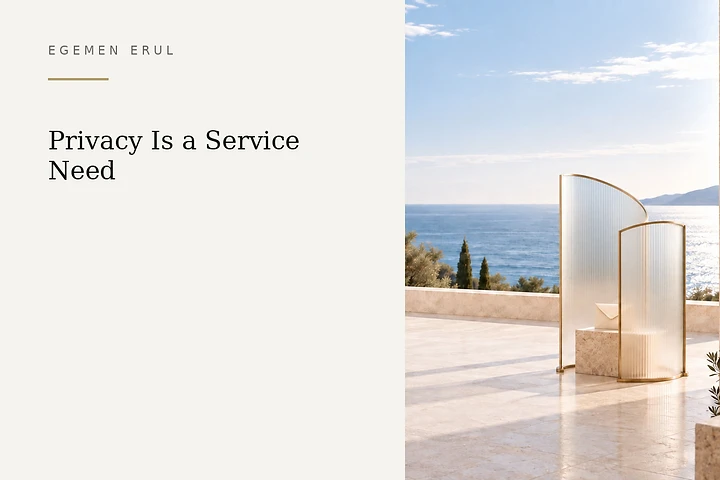
Privacy is an invisible wall behind good service. It does not remove the customer from the process; it allows the customer to participate comfortably and with control. The right information is collected, transferred to the right person, protected for the right period and removed from the process when it no longer serves a purpose.
Good service knows the customer. Excellent service protects the customer’s boundaries while learning what matters. Privacy is therefore not an exclusive extra reserved for high-profile guests. It is a basic need in every service that respects the person.
Frequently asked questions
What does privacy mean in service?
It means using customer information, preferences and plans only for a defined service purpose, preventing unnecessary visibility and behaving with professional restraint throughout the journey.
Do privacy and transparency conflict?
No. Privacy prevents unnecessary distribution, while transparency explains why information is used. They work together when the service is well designed.
Does personalisation require collecting a great deal of information?
No. Personalisation is not about collecting more data. It is about interpreting necessary information accurately and applying it with care.
How should customer information be shared within a team?
It should be shared according to role and responsibility. Each person should receive only enough information to complete the assigned task.
How does privacy improve the customer experience?
It supports open communication, more relevant recommendations, fewer repetitions, better time use and greater confidence throughout the service journey.
Sources
- European Union. Regulation (EU) 2016/679, Article 5, principles relating to processing of personal data. https://eur-lex.europa.eu/eli/reg/2016/679/oj/eng This source supports the relationship between privacy, data minimisation, transparency and control.
- National Institute of Standards and Technology. NIST Privacy Framework. https://www.nist.gov/privacy-framework This source supports the relationship between privacy, data minimisation, transparency and control.
- Martin, K. D., Borah, A., and Palmatier, R. W. (2017). Data Privacy: Effects on Customer and Firm Performance. Journal of Marketing, 81(1), 36–58. https://doi.org/10.1509/jm.15.0497 This source supports the relationship between privacy, data minimisation, transparency and control.
- Acquisti, A., Brandimarte, L., and Loewenstein, G. (2015). Privacy and Human Behavior in the Age of Information. Science, 347(6221), 509–514. https://doi.org/10.1126/science.aaa1465 This source supports the relationship between privacy, data minimisation, transparency and control.